Showing posts with label Enrichment. Show all posts

Tuesday, March 17, 2015

"I want one!".....but, do you really?

I am spending my vacation at an unbelievable and beautiful villa on the Caribbean called Baraka Point.  As if meeting the toucans on the island wasn't enough, I have been fortunate to meet many animals on this trip, including the Red Footed Tortoises that live here at the villa.  We were also treated to a visit to Richard Branson's Necker Island which is home to many different animals.

A 66 year old female Aldabra Tortoise from Necker Island

One of the Red Foot Tortoises from Baraka Point
I am on several different bird/parrot facebook pages and forums, including pages that list baby birds and adult rehomes looking for new homes.  So many times I see people exclaim "I want one" after seeing a picture or a video of a bird that they like the look of.  Many times they don't even know the species or anything about it, it may even be a wild animal or a species that is not legal to keep.  Still they "want one" because of how the animal looks in the picture.  Not the best way to choose a companion animal!  Maybe they are saying this jokingly and don't mean it, but judging by the number of parrots and other animals looking for new homes, sometimes just after a few short months once the owner realized that the adorable parrot they had to have is actually quite loud, demanding, messy and a lot of work is something that they "don't have enough time for" indicates that a LOT of people bring home a new pet without giving it nearly enough thought.

I have worked with tortoises in the past and after spending time with Nemo, the California Desert Tortoise that I have agreed to be a "godmother" to, I have become more interested in learning about them, their requirements and how they live.  Naturally, I was drawn to the tortoises here and Rick and I have been feeding and watering them daily since we got here.

Nemo, Native Bird Connections Ca Desert Tortoise, my "god tortoise"
Needless to say, I am enjoying these tortoises.  It would be very easy for me to say, "I want one!" beause of my newfound interest in them.  Okay, fair enough, they are cool and truth be told, I have thought, "Wow, I could have one of these guys".  If I am going to truly consider this, or any new animal, I have to seriously think about what this means and weigh all the realizations and possibilities.  Here are some of the things I need to look at and what I need to consider:

  • Do I have the time?  I have a lot of animals already.  Several dogs, birds, cats, my doves.  Bringing in another animal would require more of my time.  I spend a lot of time hanging out with my animals, but there is also the cleaning, feeding and other things I need to invest time in associated with them.
  • Do I have the space?  The tortoises here have a large, outdoor space here.  Because of the climate they do not need an indoor space, but if I were to keep a tortoise at my home I would need an indoor and an outdoor space.  It would need to be large, tortoises require a decent amount of space.  I would also need lamps, water sources and all of that takes up space.
  • Do I have the information?  I am always working to gain as much knowledge, experience and skill development in working with, keeping and handling any animals that I am responsible for.  Taking on a whole new species requires a whole new world of animal care to learn about.  This is something I take seriously and would be a big project for me.
  • Can I make the commitment?  Tortoises can live for a very long time.  Can I commit to an animal that may live up to 50 years?  If I got a young tortoise it could outlive me!  
  • The impact on my other animals.  I have a houseful of animals that I am committed to, responsible for and who count on me.  Is it far to them for me to have to make room, find time and give part of their attention to another animal.  With my dogs, I purposely choose to live with dogs who do well in groups, that thrive on the attention and interaction of one another as well as with me and my husband.  This is why it works, they get along, they are dogs that are bred for and thrive on being around other dogs.  Bringing in another species changes everything.  Not to mention that my dogs have not been around tortoises, what would they think?  
  • More work.  I spend a lot of time not only interacting with and training my animals, but also cleaning, preparing food and caring for them.  My dogs eat twice a day with their second meal including a dehydrated food that must be rehydrated with water and then left to sit before being mixed with their other food.  The birds eat twice a day with their breakfast including a soft, wet, fresh food meal that must be removed after a few hours.  Several of our dogs eat in crates so their crate pads have to be changed and cleaned.  Bird cages have to be cleaned.  The dove aviary has to be cleaned.  Areas have to be vacuumed.  Cat boxes have to be cleaned.  You get the idea.
  • More money.  My animals eat well.  I am proud of this and it is important to me to be able to provide this, but it isn't cheap.  I use fresh foods, store bought diets from local pet supply stores and order a lot online.  Dogs and birds require a lot of toys and enrichment, so I spend an obsene amount of money on dog and bird toys and enrichment.  In addition to food and toys there are also vet bills.  If you think routine dog and cat veterinary care is expensive, you don't even want to know about bird care.  The list goes on.  Financial impact is something to think seriously about.
When I am an honest and lay it all on the line, it becomes clear to me that no, I am not in a position to add a tortoise to my family.  It would require more time, space, money and commitment that I am prepared to offer right now or for the next 50 years.  I won't say that it isn't something I won't consider in the future, but I am currently pretty busy with owning a business, having a husband, several dogs, two cats, a flock of birds and volunteering with a wildlife education program and simply don't have time.  I will continue to respect and admire the tortoises, toucans, lemurs, flamingos, macaws, cockatoos and the people who are able to provide for them correctly, from a distance.  Instead of "wanting one" and taking one home, I will take home pictures, memories and admiration.  


Friday, March 13, 2015

My Adventures in Toucanland!

A few years ago I started seeing these fantastic toucan photos on Facebook.  Nearly every day these amazing, close up shots of these gorgeous, colorful birds would show up on Facebook.  I saw that they all came from a page called Adventures in Toucanland.  I "liked" that page and began to follow it.  I also went to the website and learned more about them.
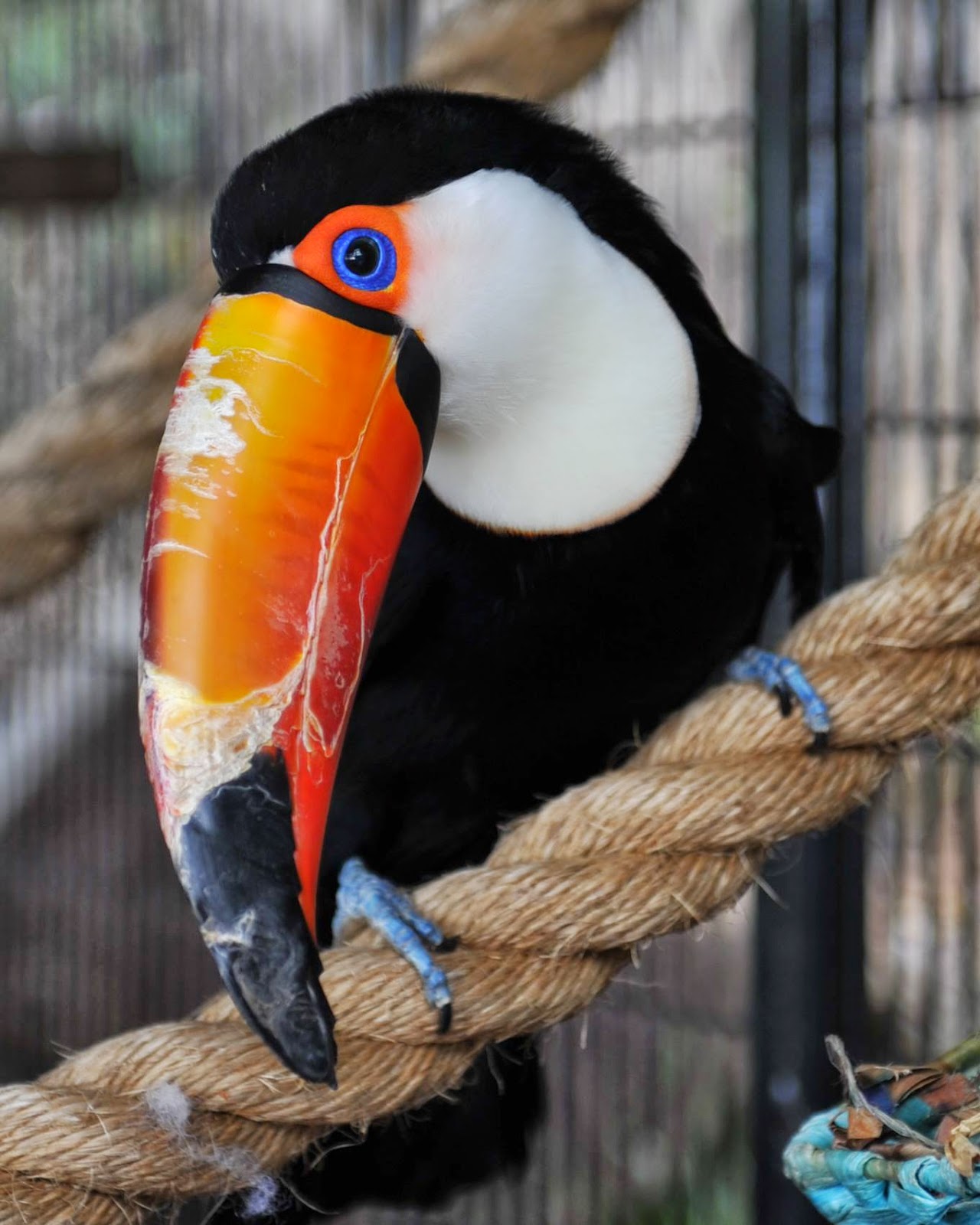
Pepe.  Photo by Mary Jones.

Fast forward to last June when our good friends took their yearly vacation to Virgin Gorda, a small island in the British Virgin Islands.  Getting there from California requires three plane rides, one from CA to NC, a second from NC to Puerto Rico and then a third ride in a terrifyingly small charter plane from Puerto Rico to the island of Virgin Gorda.  Our friends were delayed and waiting on the charter plane when they started chatting with a woman that they were sitting next to.  They started talking about where they're from and what they do.  When the woman mentioned that she has toucans my friends told her that they have a close friend who trains birds and is always sharing toucan photos.  It turned out, of course, that they were talking with Chrissann Nickel of Adventures in Toucanland.  When she asked who their friend was she immediately told them that she had been friends with me on Facebook for some time and knew who I was!  Later last year our dear friends Mary and Donna invited my husband Rick and I to join them on their next trip to the Virgin Gorda which would be next March, which is, as it turns out, right now.  Yes, I am writing this blog, sitting on a couch inside an unbelievably beautiful villa looking out the open door to the Caribbean.  The villa and staff are amazing and most of our vacation consists of us hanging out around here, lying in the sun, snorkling, swimming, eating fabulous food, drinking fabulous wine and of course, a visit to meet the toucans!

We had the pleasure of being invited by Chrissann to come and meet her and visit with and meet the toucans.  I can't tell you what an extraordinary honor it was.  To get to see them up close, to be allowed to feed them blueberries and ask her whatever we wanted was a once in a lifetime event.  When you hear "Adventures in Toucanland" you might think that it is some kind of attraction or amusement park, but that is hardly the case.  The birds live on a hill above Chrissann's home in large enclosures set up for their well being.  It is a little bit of a climb to reach the enclosures, but so worth it!

My husband Rick, Paz and I.  Photo by Mary Jones.

When I first started following Adventures in Toucanland which is the name of their Facebook page and website, I didn't know the whole story and just assumed that these birds were her "pets".  I know people who keep the smaller species of toucans, aracaris and toucanets as pets, so I assumed she had aquired these larger Toco Toucans because she wanted them as pets.  I quickly learned that wasn't the case at all.  Pepe, Paz and Paco as they are named were rescued from a business here in the BVI that uses animals as a money making attraction.  Their main source of income is offering people the opportunity to "swim with dolphins".  Unfortunately, the dolphins are kept in substandard conditions, not offered what they need in terms of enrichment or care and basically exploited for money.  Sadly, the public doesn't know that  and tourists pay good money for the opportunity to swim with them.  In addition to the dolphins, they also used to keep birds including the toucans and several species of parrots.  None of the animals were being cared for properly and they decided that the birds, who they considered nothing more than a burden to care for and not money makers needed to go.  Chrissann agreed to take the "Three Cans" as they are affectionately known and made arrangements for the parrots to go someplace else.

What Chrissann and her partner David have done for these birds is pretty extraordinary to be sure.  Chrissann readily admits that while she is grateful that she was able to save them and is happy that she can give them this life, she did not know at the time how it would change her life. They can no longer zip off the island to get away, which I have learned is an important part of island living.  The island is not big, and part of the attraction is being able to leave and get away, which is not so simple now that they care for these birds.  All of the birds have large enclosures that I found to be well suited, filled with enrichment and toys, appropriate perching, clean and with fresh food.  Pepe's enclosure is designed differently, with a raised bottom and low perching to accommodate for his disability.  He can't fall far in this enclosure which makes it safe for him.  Chrissann took the time to learn and understand operant conditioning and positive reinforcement training in order to help the birds learn to trust and become more comfortable, but also to teach some management behaviors.  It is clear however, that even with everything they have offered, it isn't enough for Chrissann, who loves her birds and despite giving them amazing lives, doesn't feel that they should be living as "pets" in this way.  Of course, there is no choice for Pepe, Paz and Paco.  These birds, while all of their history is unclear, could no longer live in the wild.

Chrissann and Paco
I want to point out that while we were allowed to see the toucans and even to go into one of the enclosures and feed the birds, we were given very specific instructions on how to behave, how to offer the food, where to be, etc.  Further, the safety and comfort level of the birds was Chrissann's priority which I greatly respected.  The birds were not treated like some kind of attraction, they are being shared with the intention of educating people.

Me feeding blueberries to Paz.  Photo by Rick Ronchette.

Mary feeding Paz.  Photo by Vicki Ronchette.
I learned so much from Chrissann during our visit.  I used to feel that the small toucans could make appropriate pets for someone who could offer the proper time, space, food, attention, etc.  Now, I definitely do not believe that the large toucans should be pets and I am not so sure I think that the small ones should be either.  Truth be told, more than the animals, it is the people who have them that is the issue.  I find there to be a small percentage of people who understand what it takes to give their parrots everything that they need.  It isn't that I don't think people should have birds as companion animals, I have several birds myself, but I find that the ease in which someone can obtain a bird like a Cockatoo or a Macaw or an African Grey to be troubling because getting the bird is the easy part, it is the providing for them corretly, day in and day out, for many many years that is the hard part.  The toucans are extraordinary.  They are beautiful, funny, exotic and amazing and they are the kind of animals that the wrong kind of person could want for all the wrong reasons.  Thankfully, toucans are not as easy to find and are quite expensive.  You don't see toucan after toucan for sale on Craigslist, sometimes as young as a year old because people bought a baby and then realized that they are loud, messy, active and demanding like we see with so many parrot species.  That is a good thing.

Pepe.  Photo by Mary Jones.
Here are a few things that would prevent me from having a toucan and things that I think people should think about strongly if they are considering trying to get a toucan or even if they think that they would make cool pets.
  • Space.  This one I was aware of.  Toucans, even the smaller species require a lot of space and not just vertical space, but also a lot of horizontal space to hop and move around.  They are extremely active and busy.  I know that I could not offer this type of space.
  • Mess.  Toucans are fruit eaters.  Birds that are fruit eaters tend to be very messy because they shoot watery poop all over.  Not easy to keep clean at all.
  • They aren't parrots.  They are social and can be handled by people if conditioned to do so, but they are a complicated and exotic species.  
  • They can be aggressive with one another and with parrots, just as parrots can be.  I know people who have both parrots and toucans and must keep them carefully separated.
Here are a few things that I did NOT know, but learned from Chrissann.
  • They can be aggressive and territorial.  While they may not be able to do as much serious damage as some animals, they certainly can do some.  Chrissann has worked hard to get her mistreated and mishandled birds to trust her, but she can't have just anyone in there and can have only a couple of people in with Paco.  Toucans look beautiful, comical and exotic, you might not think of them as dangerous, but they can certainly be intimidating.
  • They need to be fed often, several times a day.  They eat fresh fruit and they don't want it spoiled, mushy or old.  
  • Space again.  Even adequate space is probably not really adequate.
  • They are very active.  Of course, there are many species of parrots that are very active too.  This is not unlike some of the active parrot species, but still something that we need to think about.  I meet a lot of people who think that a parrot can just sit quietly and do nothing all day on a perch which isn't the case.  It's not the case with toucans either.
  • Everyone on the planet is not bird obsessed like me.  It isn't easy for her to find help with socializing with her birds, working on training or helping to care for them when she is away.
Most of all, I learned that these birds are extremely intelligent, demanding, active and not at all easy to keep properly.  I thank Chrissann Nickel as well as Paco, PePe and Paz from the bottom of my heart for the opportunity to meet you and your amazing birds.  I also thank our friends Mary and Donna for bringing us here and feeling that it was important that we experience Baraka Point in the Virgin Gorda and the toucans.  I feel like while I still have so much to learn, I have learned a lot and feel a bit more armed to talk about the reality of living with and caring for toucans.

Chrissann Nickel, Paz and I.  Photo by Mary Jones.
Please consider visiting the Adventures in Toucanland website to learn more about PePe, Paz and Paco but also to learn about toucans in general.  Also, please like the Adventures in Toucanland Facebook page to enjoy daily photos and stories of the Three Cans to learn more about them and to share and help to educate others about them.

Wednesday, March 26, 2014

Spring Changes

Charlie is our 21 year old White Fronted Amazon that we adopted last year.  He is the second WFA that we have had.  I adopted Merlin as a 34+ year old bird with health problems who passed away after two years.  I adopted Charlie knowing that he "prefers men".  He clearly prefers my husband Rick, and the two have formed a close relationship.


Almost exactly in tune with the Spring forward time change, Charlie began to change in some ways.  He seems restless, bored and frustrated some of the time.  He calls to us much more often.  He calls with a cute, "woo woo" whistle, and we respond with the same whistle.  I increased his foraging opportunities, changed his toys and am trying to make sure he gets plenty of sleep.


Today, I was hanging out in my bird room/office and working on the computer and he began to make a loud whistle sound.  Not a scream, but a loud whistle, that is not a sound I want to hear all the time!  He continued with it for a while and I ignored it.  After a little while, I left the room.  Partly because I needed to go into the other room, but partly because I wanted him to recognize that when I hear that, I go.  Once he was quiet and making quieter noises, I came back in.  He didn't make the noise anymore, but was still restless.  I realize that he is needing some more mental stimulation and possibly exercise.

After I came back in, I did a little training with him.  Nothing big, just a little work on stick training, to which he is was very into.  Then, I moved a bottlebrush stand, that I use for one of my other birds, over to him.  I moved it close enough so that he could reach into the food cup from his cage.  I put some treats in there. He did not get onto the stand (I don't think) but he did take the treats and step onto the seed cup a few times. After about 30 minutes of this, he quietly went back into his cage and is grooming and getting ready to nap.


I realize he needs something, he needs more to do and think about.  Here is my plan:

  • Increase his training sessions
  • Start teaching wing flapping for exercise
  • More foraging opportunities 
  • More toy changes/rotations
  • More shower/misting training (he doesn't like it, but is getting more comfortable with it and I know he needs it)
  • A new stand of his own to put near his cage for another play to forage and play
  • As soon as the weather is good, I will be working on getting him out into the aviary for sunshine, fresh air and a little flying around


Sunday, November 10, 2013

Stick Training Charlie

Charlie is my 20 year old White Fronted Amazon. When I adopted Charlie a few months ago, he was very fearful of the stick. He would sometimes step onto a stick for someone, but only after he felt he had no choice. This is using negative reinforcement, which means that something aversive goes away, in this case, the stick stops chasing you, when you do the behavior...stepping onto the stick. As you can imagine, it can be relationship damaging but it can also make the stick a scary thing. Also Charlie is more comfortable with men than women and part of what I am trying to do is make him more comfortable with me.  Doing something frightening, like chasing him with a stick, would not be helping to further our relationship and take it in the direction I want to go. I want Charlie to feel comfortable and safe around the stick and around me.

I set out to stick train Charlie using positive reinforcement and by shaping the behavior. Shaping means that you slowly build the behavior and reinforce all approximations towards the complete behavior.  Essentially, I started out by reinforcing Charlie for looking at the stick, then moving towards it, for staying near it, for putting a foot on it, then two feet one it, etc. 

The process can vary in how long it takes to get to the goal behavior. It depends on many things including the animals learning history, their individual personality and temperament, the skill level of the trainer, how often training is done, past life experiences for the animal and so much more. It probably took a couple of weeks of my working on this sporadically for us to get to where we are. Had I worked on it more often, we would have gotten to our end goal much faster.

The most important thing with this training is that you take your time and allow the animal to take their time. Do not push or force or pressure the animal. Instead, take what the animal can give you and reinforce that.

In this video I am usually using pieces of cashew, sometimes a safflower seed and on a few occasions a sunflower seed to reinforce Charlie's behavior.


Monday, October 28, 2013

Introducing New Foods

The best diet for birds is a varied one.  Variety is very important and this is where a lot of people go wrong. All of my birds get some pellets, some seed, either loose or in the form of nutriberries and fresh food daily. The fresh food is different all the time depending on what I have made for them or what I decide to choose. Here are some of the things that I make them for their fresh food meals:

  • Mash - For my mash I usually use a brown rice base.  To that I add vegetables which can be chopped, cut up or food processed depending on your birds and how they prefer their food. Sometimes I use a frozen veggie mix.  I will also sometimes through in some raw pasta, baby food, raw oatmeal and ground flax seed.  Sometimes I add in one of the ready made mixes like Goldenfeast, or Krazy Korn as well. You can be creative.
  • Grain Bake - I just recently learned about these and started making them.  Basically, you fill a baking dish with different grains, cover it with water and bake it for an hour at 350 degrees.  I have put brown rice, pasta, oatmeal, fruits, veggies, just whatever!  Again, you can be creative!
  • Bird bread or muffins - I love to make bird bread or muffins for the birds and they love eating them.  I will sometimes buy a bird bread mix such as Avian Organics or Mama Bird which basically contains everything you need and simply fix that.  Other times, I will use a muffin mix, like Jiffy, add some veggies, seed, pellets or whatever you think your bird will like and cook it up.  The birds love it and it can be a great way to convert a seed only eating bird.
  • Many times I simply cut up veggies for them.  I usually cook sweet potatoes and carrots, but leave things like squash raw.  I offer fruit as well, but more veggies than fruit.  I sometimes offer lettuce, which for the small birds, I hang in the cage.  It doesn't have a huge amount of nutritional value, but it is still enriching and they love it.
  • Chop - You can make a chop by simply chopping or food processing (depending on the size of your bird) and mixing it all together.
  • Dry mixes - I buy different dry mixes and keep them on hand for days when I will be gone long and unable to take out the wetter foods that may spoil.  I offer veggie crisps, dried fruits and veggies, mixes such as My Safe Bird Store's Quacker Jax, Bountiful Harvest or Veggie Crisp.  Sometimes I make my own by throwing in a bunch of dry pasta, some dry cereal like cheerios and shredded wheat, some dried veggies, etc.
  • Other stuff - I save leftover pasta and will throw in some veggies and offer that.  I sometimes make my birds scrambled eggs and a little wheat toast.  I sometimes offer comfort feedings of warmed baby food, mixed with a little oatmeal.  
  • Skewers - Some birds love to eat hanging food.  Try using a skewer and hanging fresh, raw fruits and veggies in the cage.  I like to do corn cob wheels, halved jalapenos, fruit, pepper pieces, just whatever you think your bird might like!
  • Many of these things can be made in large batches and divided up so you have some for now and some to freeze.
  • Remember when feeding fresh food that is wet or moist to take it out of the cage a couple of hours after serving it so that it doesn't spoil.
Merlin enjoying some squash


Iris with a dirty mash face


Argyle eating a rigatoni


 Ivan enjoys a muffin


 Nemo eating some bird bread


Always offer fresh food first thing in the morning.  This is when the birds are most hungry.  I do not ever withhold food to get them to eat something else, but I will feed the things that they eat more readily after having offered them something fresh.

When I am offering a new food to the birds, I usually sprinkle some seed and/or pellet on the top or even incorporate it into the new food to get them to try it.  I have found that when doing vegetables, many birds love corn and peas, so you can try those.  

With some birds, if hold the food, look at the food and even pretend or actually eat the food, they will give it a try.

Most birds will try it if they live with other birds who eat it.  So, if you have groups of birds living together, one may start and get everyone to try it!

I offer it every day and continue to offer it, even if they don't eat it.  It can take quite a while for birds to realize that something is edible and to actually want to try it.

Be creative!  Don't be afraid to try new things, just make sure that they are bird safe.